The warmer the beginning of the year, the earlier trees shed their leaves
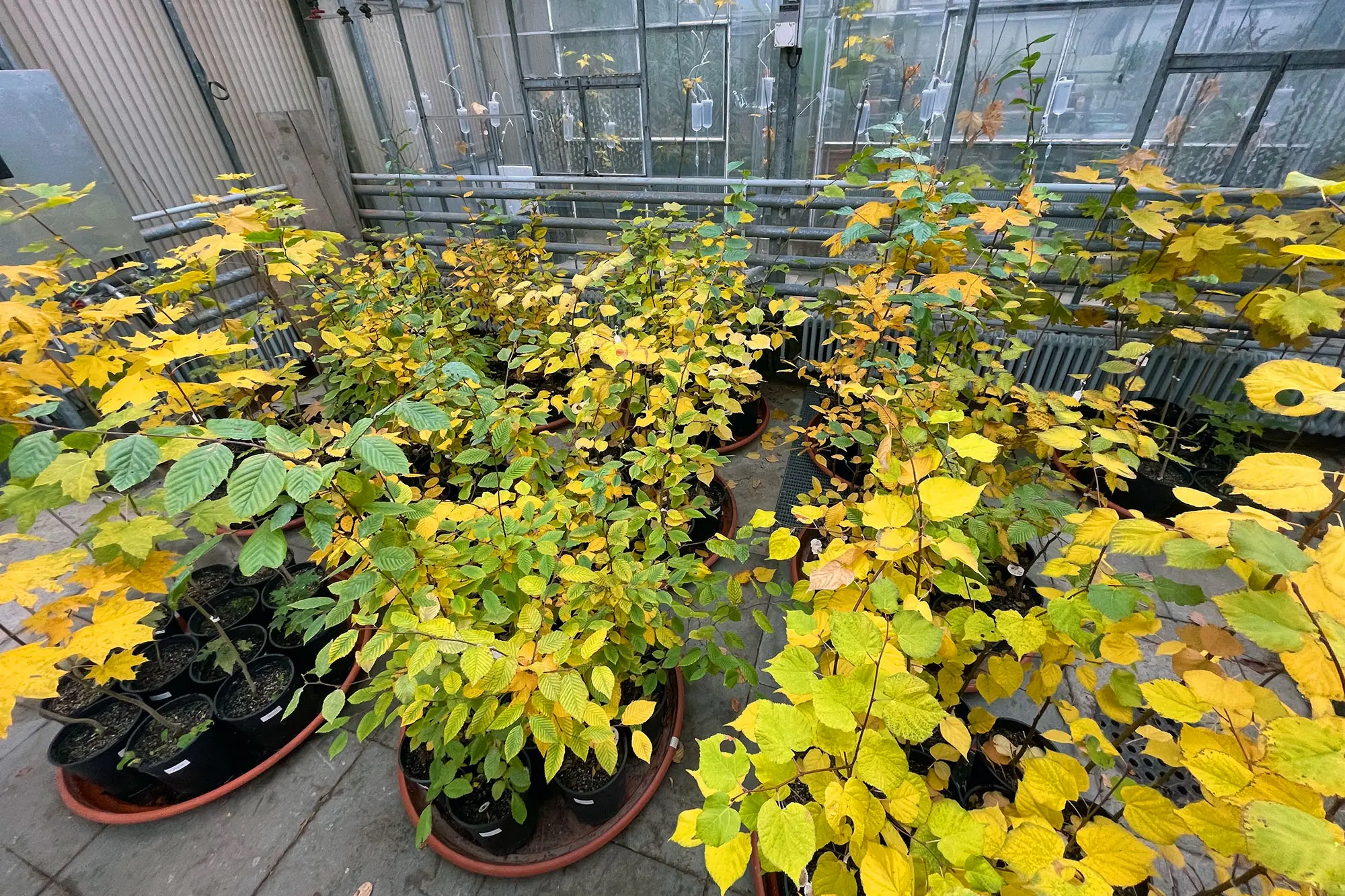
The rate at which tree leaves age over the course of a year is not set in stone. Models that predict the effect of climate change on vegetation and the carbon cycle should take this variation into account.
This year has clearly demonstrated that autumn colours and leaf fall can begin already in summer. Heat and drought caused some trees to shed their leaves as early as July. The consequences that this will have for the forest are unclear and will depend largely on whether such extreme climatic events recur.
The discoloration and shedding of leaves, also known as senescence, is usually an actively initiated and controlled process. Before the first frost arrives, trees reabsorb nutrients from the leaves and store them in their branches, trunk and roots. This creates a reserve that can be remobilised for the development of new leaves the following spring.
Forest ecology researchers now suspect that last summer many trees failed to reabsorb and store these precious nutrients in time – before the heat and drought damaged their leaves and natural senescence took place.
Cold is not the only trigger
However, not all early leaf senescence is involuntary, as a team led by ecologist Yann Vitasse, funded by the SNSF, has now demonstrated. The researchers have shown that favourable warm conditions in spring can also trigger normal but early leaf senescence. Depending on the species and circumstances, it can begin up to several weeks earlier.
It was long assumed that low temperatures and shorter days in autumn signal the start of leaf senescence. But this explanation alone is not sufficient. "Models based solely on autumn temperature and day length fail to predict the timing of senescence accurately," says Vitasse, research group leader at the Swiss Federal Institute for Forest, Snow and Landscape Research (WSL).
Small-leaved linden saplings put to the test
So, there must be other factors at play. Recent studies have suggested that warmer temperatures at the beginning of the growing season could influence the timing of leaf senescence. Vitasse’s team has now specifically tested this effect in an experiment using saplings of three common native deciduous trees: the European hornbeam, the small-leaved linden and the Norway maple.
For the experiment, 48 potted saplings of each species were kept in open greenhouses. Half of these served as a control group and were exposed to the natural ambient temperature. The other half were warmed from January through mid-June, keeping them around five degrees Celsius warmer than the control plants.
After the summer solstice, all the trees were returned to the same conditions in an unheated greenhouse. During the experiment, the researchers observed when the leaves emerged, how quickly the saplings grew and accumulated reserves, and when leaf senescence began.
Early growth, full reserves
They found significant differences between the trees that spent the first half of the year in warmer temperatures and the control trees: The former produced their leaves two to four weeks earlier. In the case of the hornbeam and the small-leaved linden, the stem diameter also increased more; in other words, they grew better. And in these two species, leaf senescence also began three to four weeks earlier.
"Our hypothesis is that, when it warms up early on, these trees invest in growth earlier in the year and build up energy reserves. This may contribute to setting the leaf senescence programme in motion earlier," says Vitasse. This is further supported by the fact that these trees had already accumulated a significant amount of starch, a substance used for energy storage, in their branches by the beginning of summer.
The Norway maple deviates from the other two
The Norway maple, however, did not follow this pattern. Although it also leafed out earlier in warmer temperatures, neither its growth nor its accumulation of starch accelerated. Leaf senescence did not occur any earlier than in the control saplings.
“In the case of the Norway maple, spring shoot growth appears to be more strongly predetermined by the previous year. It is therefore less responsive to favourable growing conditions,” says Vitasse. Such differences highlight how important it is to always include different tree species in experiments.
Leaf fall influences the carbon cycle
It is not yet clear exactly which factor determines early senescence in tree species such as the hornbeam and the small-leaved linden: the early leaf emergence itself, the resulting accelerated growth or the associated accumulation of reserves.
Vitasse now aims to investigate this in new projects funded by the SNSF. He is planning to conduct further laboratory experiments, in addition to field observations and satellite data analysis. The researchers also intend to examine the effect of drought on leaf senescence in more detail.
"We urgently need this information to predict how vegetation and the Earth’s carbon cycle will respond to climate change," says Vitasse. This is because such models must take into account how much carbon forests will be able to absorb in the future. Leaves capture CO2 through photosynthesis. An earlier end to the growing season could therefore shorten the period during which forests sequester carbon.
Five degrees warmer in spring
The five-degree Celsius temperature increase simulated in his experiment should not be considered a direct prediction of average future warming, says Vitasse. But such unusually warm spring conditions could become more frequent under climate change.
The contrasting responses among tree species also underline the importance of maintaining diversity in forests. "The more diverse the species, the greater the resilience to stress and major environmental changes."