Ten years of spectacular scientific images
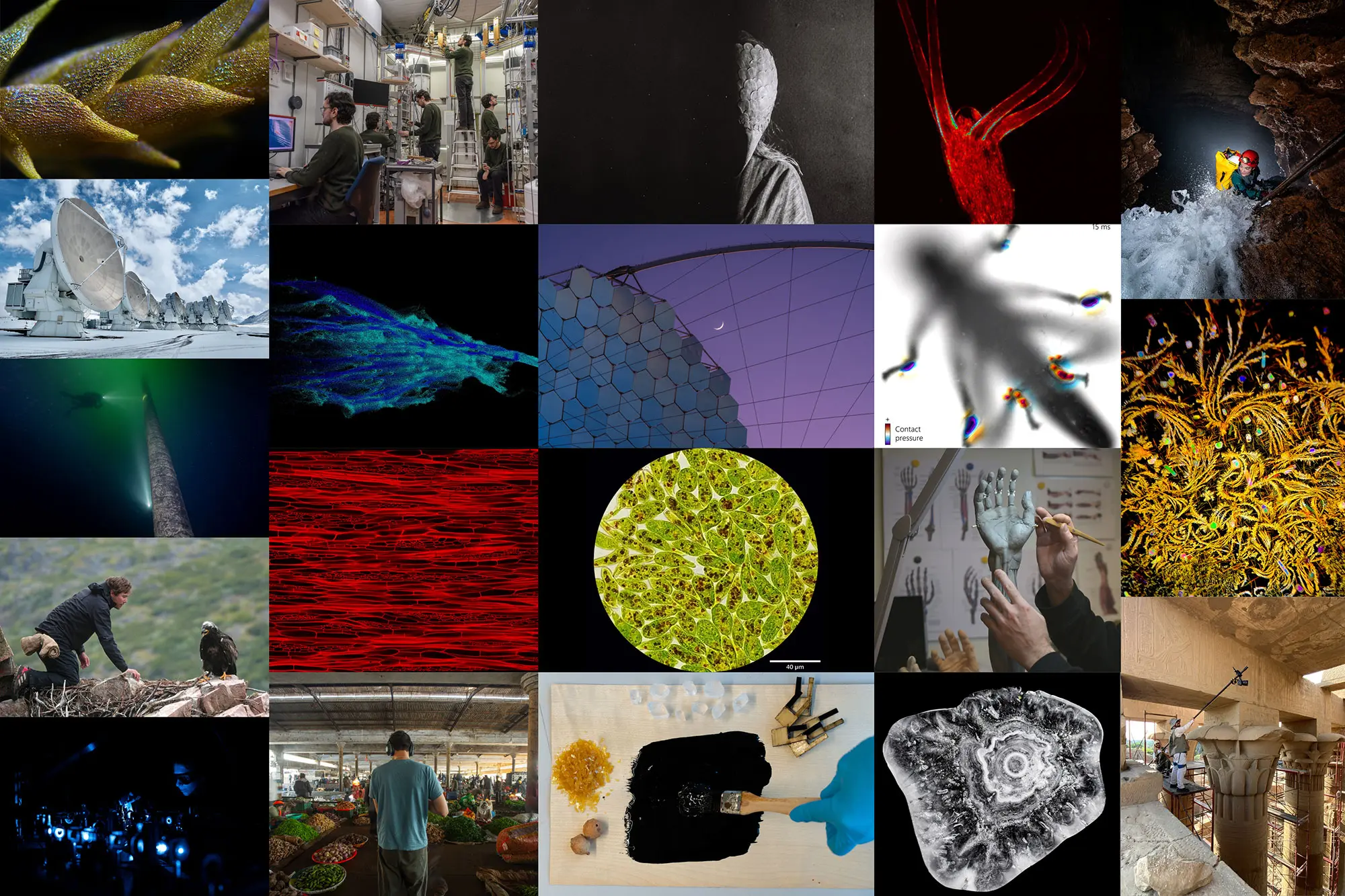
The SNSF Scientific Image Competition 2026 will award prizes to 20 works ranging from a bird mask to an underground river. Over the last ten years, it has collected more than 3,800 images that offer unusual insights into research.
A strange encounter at the bottom of a Swiss lake, a photomontage documenting the daily life of a solitary researcher, a close-up of a hailstone capturing its formation in a cloud: The international jury of the SNSF Scientific Image Competition 2026 awarded four first prizes and sixteen distinctions from among the 314 works submitted to the competition organised by the Swiss National Science Foundation.
The winning images and videos can be viewed at the Biel/Bienne Festival of Photography from 9 to 31 May 2026. "Our collaboration with the Swiss National Science Foundation allows us to discover science in an unexpected light," notes Sarah Zürcher, who took over as the festival’s director in 2025. "Although not strictly artistic in the traditional sense, these images open up new perspectives on how knowledge is constructed and shared."
The top four prizes
Anthropologist Claire Galloni d'Istria from the University of Geneva won the "Object of study" category for her photo of a colleague wearing a bird mask. "This photograph is a way of conveying my thoughts on the coexistence of humans and animals," she explains. "For me, photography does more than simply illustrate: It produces other forms of knowledge." The jury praised the "dramatic staging and the radical framing that highlights a slightly disquieting darkness."
First prize in the "Women and men of science" category went to Mirjam Widmer, a student at Zentrum Bildung, for her portrait of a cave scientist in the midst of an underground waterfall. For her, this photo shows "that research is not just carried out in a lab and that acquiring knowledge requires courage and physical effort." The jury described it as "a technical tour de force that masters lighting and composition and plunges us into an almost inaccessible universe."
Jayant Abhir, a PhD researcher from ETH Zurich, won the "Locations and instruments" category for his photograph of the moon seen through the cabled structure of a telescope situated at an altitude of 2,200 metres on La Palma. "There’s a very special atmosphere there that I'm trying to document through photography," he explains. For the jury, the photo’s "sophisticated composition juxtaposes the mechanical and the natural, the near and the far, the abstract and the figurative."
The "Videos" category was won by Inés Segovia Campos from the University of Geneva for her microscope footage showing the collective movement of phytoplankton. "It shows how these single-celled algae adapt to their environment and struggle to find their place," she explains. The jury was seduced by this "classic, precise shot in intense colours that reveals a microscopic world."
Sixteen distinctions were awarded to other works that allow viewers to discover the delicate iridescence of a moss, dazzling vitamin B crystals, blood-red balsa wood or a face-to-face encounter between a biologist and an eagle on a cliff in Greenland.
Ten years of scientific images
Launched in 2017, the SNSF Scientific Image Competition has gathered more than 3,800 images documenting the activities of scientists working in all disciplines and research institutions across the country. They are available in an online gallery and can be used for non-commercial purposes as well as by the media.
“For ten years, the competition has presented a realistic view of the work of researchers in our country," comments Torsten Schwede, President of the SNSF Research Council. “These images bear witness to the commitment and creativity of the researchers who are advancing knowledge and opening up a valuable dialogue with society."
The 2026 jury
The jury is chaired by Patrick Gyger, director of the Plateforme 10 arts district in Lausanne.
The other jury members include:
Jessica Hallett, media editor, Nature magazine (England)
Andri Pol, photographer (Switzerland)
Tess de Ruiter, curator of art-science projects, Rotterdam (Netherlands)
Aurélie Saliba, crowdsourcing manager for Adobe Stock (Germany)