BRIDGE Discovery: flexible refrigerant mixtures make heat pumps more efficient
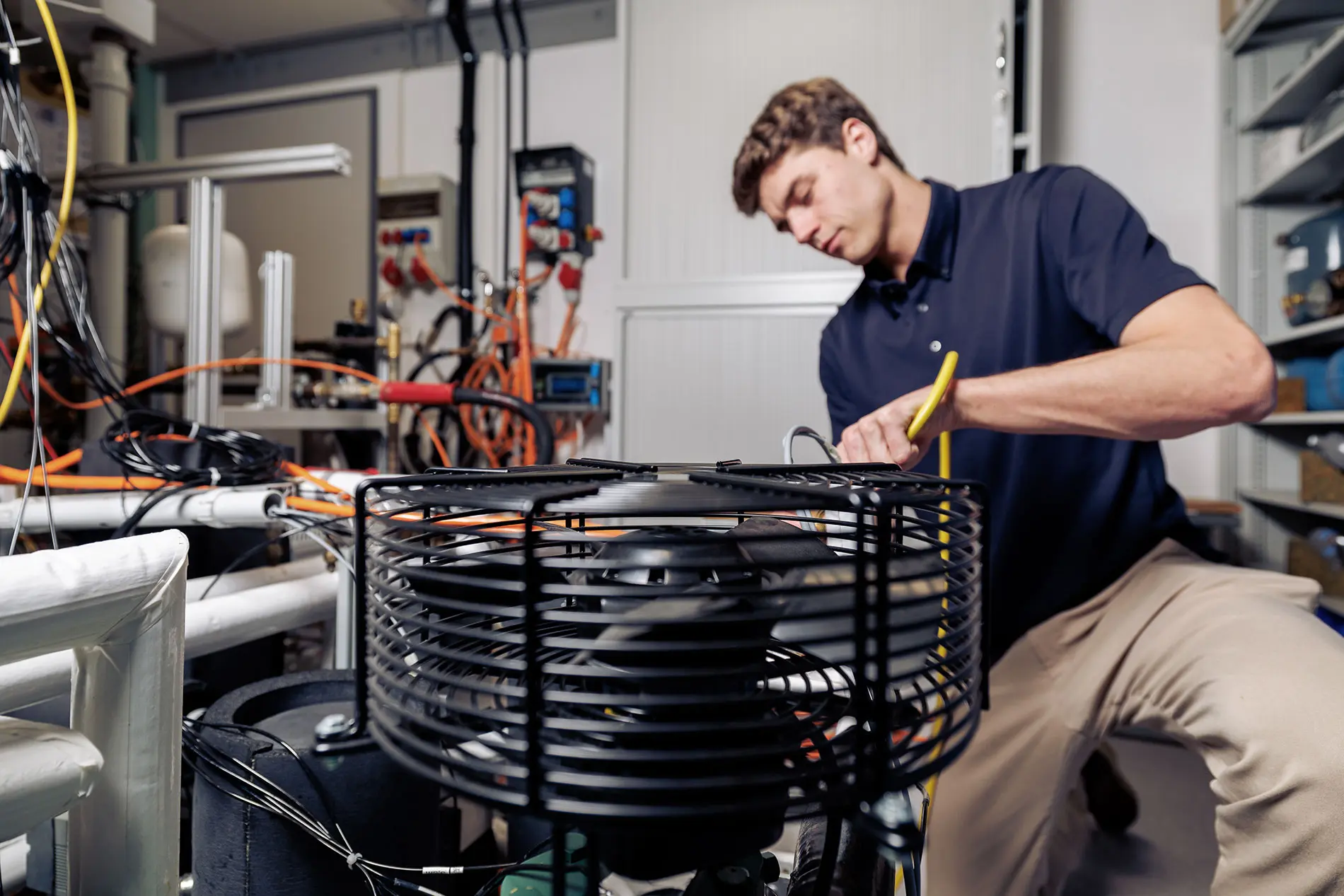
ETH Zurich and the Eastern Switzerland University of Applied Sciences tested refrigerant mixtures for heat pumps in a BRIDGE Discovery project. This will benefit both research and industry – Lindt & Sprüngli plan a pilot plant.
Whether for food, chemical or pharmaceutical production, industrial processes with temperatures of up to 200 degrees Celsius consume around 33 petajoules of heat per year in Switzerland. That is over 50 percent of the heat required by the entire industrial sector. Heat pumps are a promising option for decarbonising energy generation. To meet the high demands and specific requirements of individual companies, they need flexible refrigerants. A team from ETH Zurich and the Eastern Switzerland University of Applied Sciences (OST) is investigating refrigerant mixtures for this purpose. Since March 2022, the project has been supported by the SNSF and Innosuisse as part of their joint BRIDGE Discovery funding programme. It runs until the end of September 2026.
"Thanks to their special thermodynamic properties, refrigerant mixtures can simultaneously increase the flexibility, efficiency and maximum temperature of industrial heat pumps," explains Leon Brendel, team leader for heat pumps and refrigeration technology at OST and leader of this joint project with ETH. "Our mixtures were initially viewed with great scepticism. Everyone feared that the components would separate," he recalls. The project team set up a heat pump model in the lab, used it to test dozens of different mixtures and were able to dispel these fears.
Pilot plant at Lindt & Sprüngli
From the outset, the project was supported by an industrial advisory board, comprising 14 companies, ranging from large corporations to small and medium-sized enterprises. This allowed the research team to clarify specific requirements and test their ideas in real-world applications. The advisory board also included Scheco AG, based in Winterthur, which develops and manufactures heat pumps. Managing Director Marc Grünig was briefed in detail about the technology by Leon Brendel and his team and is now backing the newly developed refrigerant mixtures. "We are delighted to be able to directly utilise the research results and apply them in a new generation of heat pumps," he explains. What impressed him most was that the technology simultaneously reduces both the acquisition and operating costs of the systems. "That’s a strong selling point for our heat pump customers," says Grünig.
For example, Lindt & Sprüngli AG, which has its headquarters in Kilchberg on Lake Zurich, is also thinking about decarbonisation. "Next year we would like to set up a pilot plant from Scheco AG at our Kilchberg site to demonstrate the technology and make the findings available to others," says Leonhard Wolscht, who is responsible for redesigning the heat supply at Lindt & Sprüngli. The chocolate manufacturer has also joined the advisory board for the BRIDGE Discovery project. "We have benefited enormously from the collaboration with ETH and OST," emphasises Wolscht.
Findings attract great interest
Leon Brendel and the other researchers have been continuously publishing their findings on refrigerant mixtures and presenting them at conferences: "We have attracted a great deal of interest. Thanks to the BRIDGE Discovery funding, we were involved at a very early stage and were able to issue important publications." Such a project can also serve as a career booster, as one can make a name for oneself and establish numerous contacts. He is therefore very grateful for the funding: "We wanted to do in-depth systematic research whilst clearly focusing on application, but without a predetermined industrial partner – in other words, exactly what BRIDGE is designed to support." Brendel is particularly pleased that concrete systems are already in the planning stage. He sums up by saying: "We were able to gain significant insights that were very well received by the scientific community and industry. And that happened even faster than expected."
The results of the project are wide-ranging: new research into refrigerants, the development of new heat pumps through concrete pilot projects and lasting collaborations between universities and industry partners. Indeed, the project has already given rise to follow-up questions that the ETH and OST project team intend to tackle together in the future.
From research to innovation
The BRIDGE funding programme is jointly financed by the SNSF and Innosuisse. It is designed to support researchers in quickly transforming their research findings into products or services.