In the Stöckli workshops, science shapes snow sports
To design some of the best performing skis on the market, Stöckli combines craftsmanship, competition and basic research. The Swiss academic ecosystem is proving to be a strategic ally in this adventure.
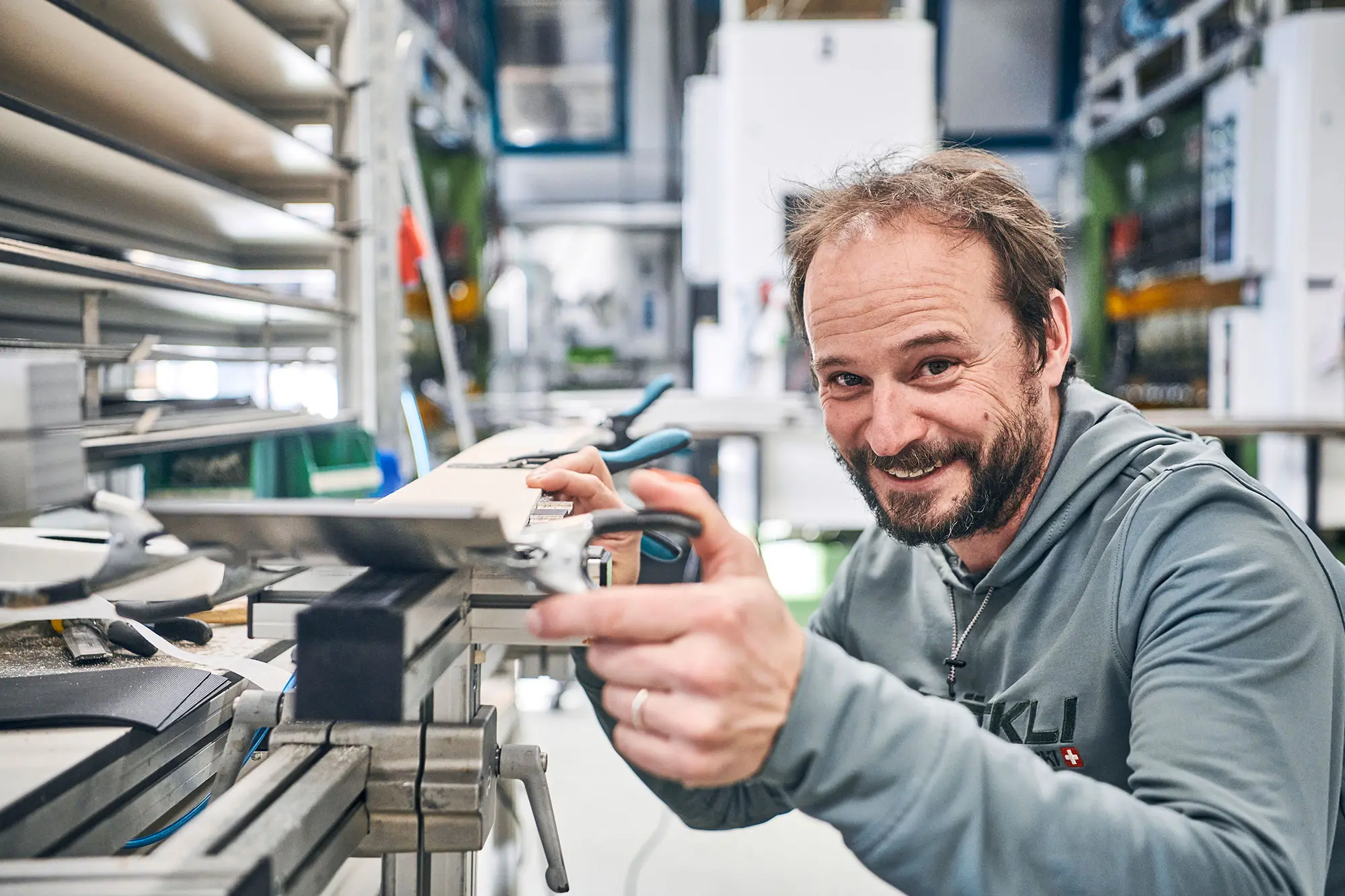
In Stöckli's workshops in Malters, near Lucerne, wood, fibres and resins are layered with the precision of a musical phrase. The Swiss ski manufacturer skilfully combines a strong heritage of craftsmanship with the automation of certain processes. The reproducibility and precision of state-of-the-art machines are complemented by the accuracy of human touch and expert eyes: Technicians adjust, press and refine. Each pair of skis is born from a constant dialogue between manual expertise and perfected industrial processes. Another, more discreet driving force also propels Stöckli – scientific research.
"If you want to optimise a ski, you have to understand the interaction between the skier, the equipment and the snow," explains Mathieu Fauve, Head of R&D Ski at the company. This approach draws on tribology – the science of friction – biomechanics, dynamics and surface physics. Snow remains a capricious and highly complex material, which reacts in ways that are still not fully explained.
At Stöckli, this scientific exploration is anything but a contemplative exercise: It has been fuelling the group's growth for decades. Over the past ten years, the company has grown from selling around 35,000 pairs a year to nearly 80,000, 65% of which are now exported, with an estimated turnover of almost 60 million francs. This economic momentum is also reflected in employment. Stöckli now has between 220 and 250 people, including nearly 80 operators at the Malters site – twice as many as ten years ago for production alone.
Marco Odermatt's skis
The research team, which used to consist of just two people, now has five members. "We've hired new staff in the last few years, which is not that common in the ski industry," says Mathieu Fauve. At a time when many brands are relocating their production to Asia, this Lucerne-based SME has made a different choice: to maintain its roots in Switzerland and work closely with universities and research labs.
To appreciate the scale of this scientific contribution, we need to turn to Davos. This is where the SLF, the renowned Institute for Snow and Avalanche Research, a long-standing partner of Stöckli, is based. Together with its teams, the company has studied the morphology of ice crystals and how they behave at different temperatures and humidity levels. This collaboration has resulted in faster bases that reduce friction on the snow.
This slight gain in speed can be enough to tip the balance in a race. The skis used by Marco Odermatt, the Olympic champion who is sponsored by the Swiss equipment manufacturer, are the result of this research. The downhill, super-G and giant slalom competitions then become an extension of the laboratory. "Some of our innovations designed for top-level sport can often be incorporated into our consumer product lines," confides Fauve. Science feeds racing, and racing validates the science.
How a tortoise shell inspired innovation
One of Stöckli's most unusual projects originated far from the slopes: in a scientific publication describing the structure of tortoise shells. During a seminar on bio-inspired materials, this idea caught the attention of researcher Véronique Michaud, based at EPFL's Laboratory for Processing of Advanced Composites. Tortoise shells have an architecture that can become flexible or rigid depending on the stresses they are subjected to.
What if a ski could behave in the same way? This intuition led to a collaboration with Stöckli in 2016. "This project is emblematic of our approach: a scientific indication followed by joint work to test its relevance and finally industrialisation," summarises Fauve. A study paved the way, then prototypes appeared in the workshop. Tests followed one after another. It took almost three years to go from idea to mass production. A few years later, this technology is still used in several of the brand's models. Original, effective and easy to explain to customers, it illustrates a successful combination of scientific rigour and market application.
Hand in hand with universities
Stöckli regularly relies on the Swiss academic ecosystem for its R&D projects. "It's a win-win situation: We move forward more quickly, while the university teams finance positions, publish and gain visibility", Fauve recounts, highlighting the strength of the links between research and industry. The company is currently exploring product lifespan and the reduction of biomechanical stress to enable skiers to ski for longer. These projects are opening up new partnerships with students and research centres, proving that the innovation loop never quite closes.
This dynamic extends far beyond the Malters factory. It involves a network of mainly European suppliers and supplies more than a thousand distributors worldwide, as well as its ten boutiques in Switzerland (five permanent and five seasonal). Stöckli's growth, fuelled by its academic collaborations, benefits an entire region and reinforces Switzerland's image of excellence.