Marcel Benoist Swiss Science Prize 2026 awarded to the biochemist Martin Jinek
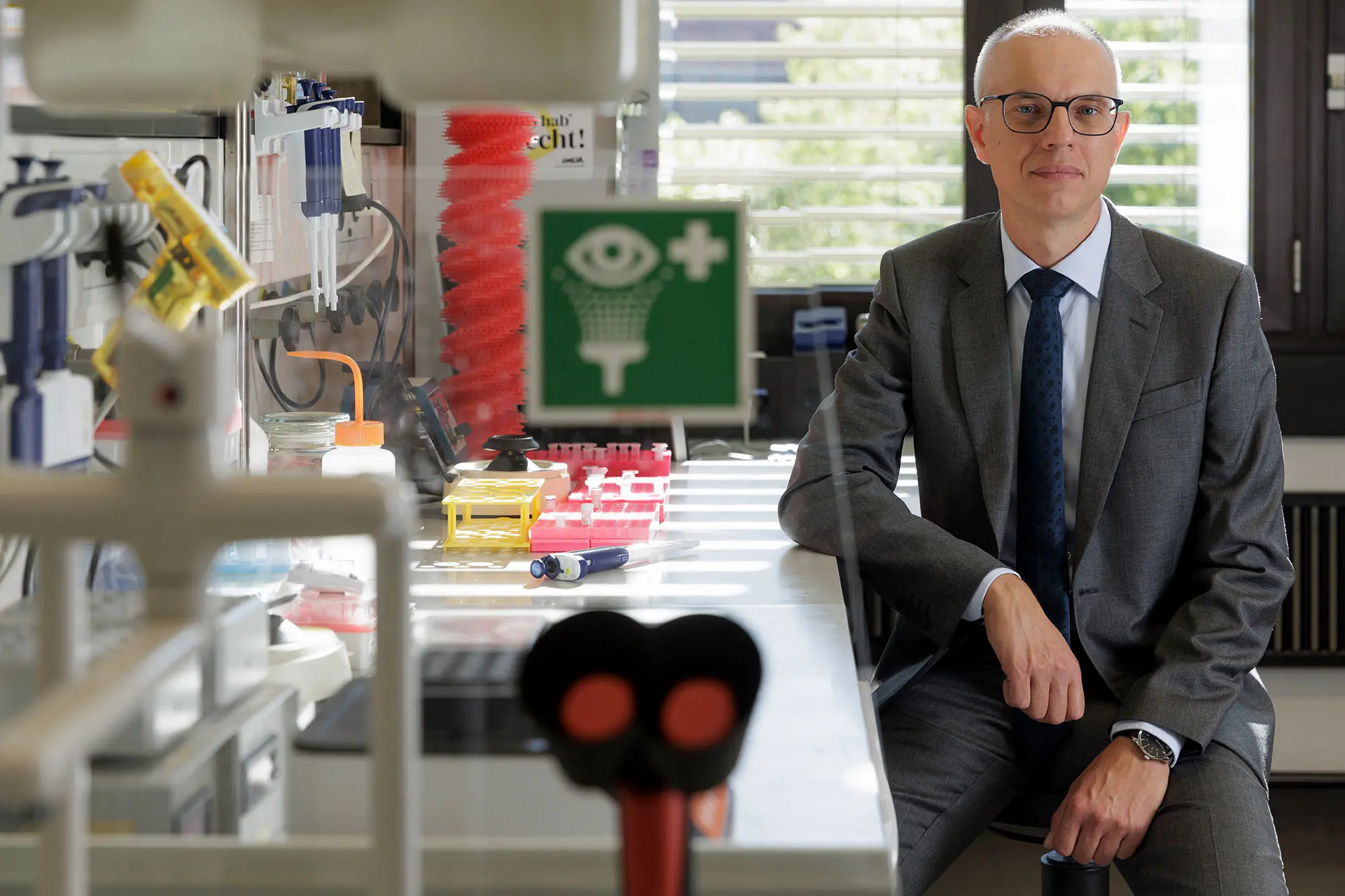
Biochemist Martin Jinek has been awarded the Marcel Benoist Swiss Science Prize for his insights into cellular processes that paved the way for a major breakthrough in genome editing.
The Marcel Benoist Swiss Science Prize, which is endowed with 250,000 francs, is regarded as the Swiss Nobel Prize. This year’s laureate, Martin Jinek, is a professor of biochemistry at the University of Zurich. He is being honoured for his outstanding research on RNA-controlled molecular systems capable of specifically targeting cellular genetic material, as well as their application in genome editing.
Together with other researchers, Martin Jinek played a key role in further developing the natural CRISPR-Cas9 system into a programmable tool for the targeted modification of DNA. This led to the CRISPR-Cas9 technology for genome editing – also known as genetic scissors – which earned Jennifer Doudna and Emmanuelle Charpentier the 2020 Nobel Prize in Chemistry.
A few years earlier, as a postdoctoral researcher in Doudna’s laboratory at the University of California, Berkeley, Jinek had made a major contribution to the landmark publication by the two research groups that laid the foundation for the genome-editing tool. Together with Krzysztof Chylinski from Charpentier’s research team, Jinek was co-first author of the 2012 landmark paper "A Programmable Dual-RNA–Guided DNA Endonuclease in Adaptive Bacterial Immunity".
On the cusp of a major breakthrough
At the time, it was already known that bacteria possess various defence systems, known as CRISPR systems. Jinek demonstrated that, in one such system, the protein Cas9 functions as a DNA-cleaving protein, or nuclease.
As he and his colleagues subsequently demonstrated, this process requires a combination of Cas9 and several RNA molecules. One of these, the guide RNA, directs Cas9 to the appropriate site within the genome of the viruses. Jinek systematically constructed different guide RNAs to direct the molecular scissors to different sites in the DNA. The approach proved successful. The researchers also managed to merge the required RNA components into a single chimeric RNA molecule.
As the project progressed, it became increasingly clear that Jinek and his colleagues were on the cusp of a major breakthrough. Suddenly, the work was no longer solely about fundamental research and understanding a bacterial defence system. The researchers realised that they had discovered, and could further develop, a tool with broad applications in biotechnology and even gene therapy, enabling targeted genetic modifications.
"I still remember the day I presented my research findings in Jennifer Doudna’s office," Jinek recalls. "I said to her: I believe CRISPR-Cas9 can, in principle, be used for genome editing. It can be programmed to determine which DNA segments are to be cleaved." She immediately recognised the technology’s potential and said: "Write everything down!"
Staying grounded
The resulting 2012 publication attracted widespread attention. Yet even in retrospect, Jinek remains remarkably level-headed: "It was an intense and extraordinary period. However, it was important to keep our feet on the ground. We still had a lot of work ahead of us, and there was so much that we did not yet understand." The research continued at full speed and once again proved successful. Following the publication, it took only a matter of months before Doudna’s team and research groups around the world were able to demonstrate the effectiveness of the method in a variety of organisms.
For Jinek, however, it was time to move on. His postdoctoral fellowship had come to an end, and the next stage of his career awaited: establishing his own research group. Europe beckoned. During his interview at the Department of Biochemistry of the University of Zurich, he immediately felt at ease with the team and sensed that his research would be welcomed there. In 2013, he established his own laboratory at the university.
From theory to application
CRISPR-Cas9 is no longer merely a theoretical tool of biotechnology. Researchers are now exploring its use in developing disease-resistant crop varieties for agriculture. In medicine, the technology has already entered clinical practice. The first CRISPR-based gene therapy was approved in 2023 and is now used to treat beta thalassaemia and sickle cell disease, two inherited disorders affecting the oxygen-carrying protein haemoglobin in red blood cells. CRISPR is also being used in cancer immunotherapy. At present, Jinek estimates that around 100 clinical trials are investigating the use of the CRISPR-Cas9 genome-editing tool for a variety of diseases.
Yet the CRISPR method also has its limitations. One of these is its limited specificity: Like earlier forms of gene therapy, CRISPR-Cas9 can occasionally cleave DNA at unintended sites. This may give rise to so-called off-target effects, which can pose risks to human health. In addition, the technology is still relatively young, and long-term clinical experience will be needed to fully assess its safety and efficacy.
With great power comes great responsibility
His focus is on making the meaningful application of genome-editing tools even more effective and safer, particularly for medical applications in inherited diseases and cancer, as well as for fundamental research. "Fundamental research was essential in ultimately enabling the development of a groundbreaking technology such as CRISPR-Cas9. This kind of research requires time and, accordingly, sustained long-term funding. This is crucial for future innovation," explains Jinek.
He is therefore especially pleased to receive the Marcel Benoist Prize in recognition of both his past achievements and his ongoing research. The work originally set out simply to understand how bacteria function. Yet that research has already given rise to key applications, thanks to the development of the CRISPR-Cas9 genome-editing tool. And still, as Jinek points out, there is much left to discover. "We are only starting to understand bacteria as living organisms. I am intrigued to find out what other surprises they still have in store for us."
Excerpts have been taken and adapted from texts by the Marcel Benoist Foundation (author: Adrian Ritter, edited by SilberMedia GmbH)
Marcel Benoist Swiss Science Prize
The 2026 laureate: Martin Jinek
Martin Jinek, born in 1979 in Třinec in what is now the Czech Republic, is a professor of biochemistry and the head of a research group at the University of Zurich. After completing his degree at the University of Cambridge, he earned his PhD at the European Molecular Biology Laboratory (EMBL) in Heidelberg and subsequently conducted research from 2007 to 2012 as a postdoctoral fellow in Jennifer Doudna’s research group at the University of California, Berkeley. In 2013, he was appointed assistant professor at the Institute of Biochemistry at the University of Zurich and promoted to full professor in 2024. Martin Jinek has received numerous prestigious awards for his research, including an ERC Starting Grant and Consolidator Grant from the European Research Council (in 2013 and 2018 respectively), the Friedrich Miescher Prize (2015) and the Cloëtta Prize for Medical Research (2026). He was elected a member of the European Molecular Biology Organisation (EMBO) in 2024.
Further information about the awardee and his research is available at the following link: https://marcel-benoist.ch/en/laureate-2026
Marcel Benoist Foundation
Since 1920, the Foundation has awarded the prize every year in recognition of outstanding research which is of particular benefit to human life, and so pays tribute to researchers who exemplify the level of excellence of research conducted in Switzerland. Eleven of these laureates have gone on to receive the Nobel Prize. Since 2018, the nomination and selection process has been undertaken by the Swiss National Science Foundation (SNSF) on behalf of the Marcel Benoist Foundation. The 2026 prize is awarded in the field of life sciences (biology and medicine).
Awards ceremony at the Federal Palace
The award ceremony (together with that for the Latsis Prize) will take place on 5 November at the Federal Palace. The chairpersons of the respective foundations will present the awards in the presence of President of the Swiss Confederation Guy Parmelin and President of the Council of States Stefan Engler.