Faced with the scent of an intruder, breeding wolves remain on their guard
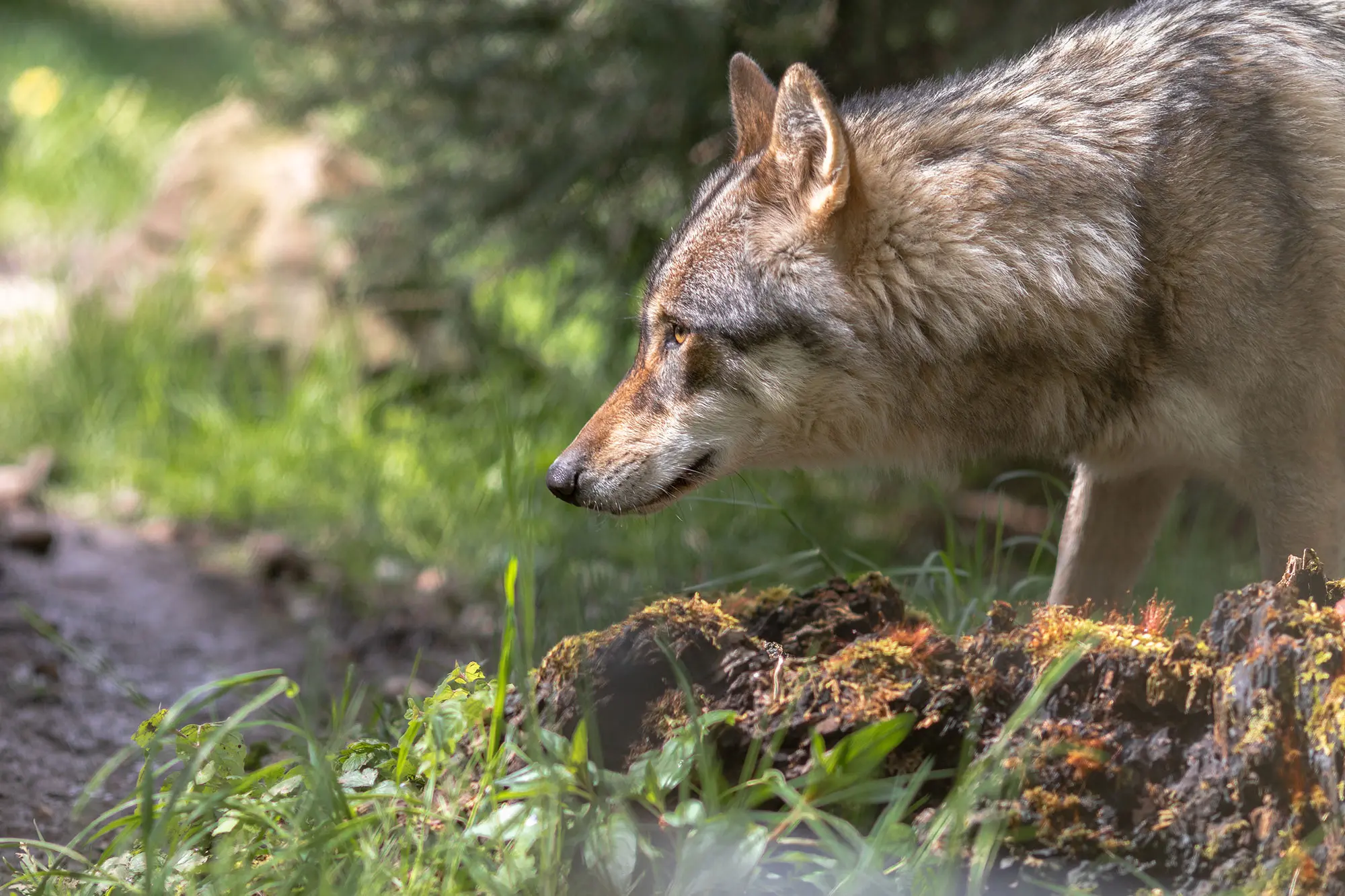
Wolves use their urine to communicate with each other. A study supported by the SNSF looked at the reactions of a pack to the marking of an intruder. This is a first step towards understanding what attracts or repels canids.
Wolves use their sense of smell – which is far more developed than ours – to hunt or avoid predators, but also to communicate with their fellow wolves. The urine marks that they leave to mark their territory contain information they pass on about their identity, rank and reproductive state. Yet this mode of communication, which is fundamental in canids, has received little scientific attention to date.
A study co-funded by the SNSF has analysed how packs living in captivity react to the olfactory signal of an intruder. In this controlled experimental setting, Giada Studer, Klaus Zuberbühler and Gwendolyn Wirobski from the Laboratory of Comparative Cognition at the University of Neuchâtel, observed much more marked reactions in breeding wolves. In the long term, a better understanding of urinary communication in canids could lead to the development of olfactory barriers against wolves.
Thirteen wolves, five packs, four zoos
Between April and June 2024, the team exposed five packs in four Swiss zoos to olfactory stations placed outside along the enclosure peripheries.
These stations consisted of an aluminium plate fixed at a height of 30 centimetres from the ground, to simulate the natural height of raised leg urination. The scientists applied three millilitres of wolf urine to these plates, protected by a wooden shelter, to mimic the presence of a wolf from outside the pack. To distinguish a specific reaction from a simple novelty effect, the researchers also used human urine.
The reactions of 13 wolves, including six breeders and seven non-breeders, were recorded continuously by camera traps and analysed.
Breeders more reactive to new scents
The result is clear: Compared with subordinate or juvenile individuals, breeding wolves with pups are much more interested in unfamiliar olfactory cues. "These animals have more to lose," explains Gwendolyn Wirobski, a specialist in animal behaviour and social cognition in canids, who supervised this study. "They have their territory, their young and their partners. It therefore makes sense that they pay more attention to this social information," she adds.
The behaviours observed were essentially exploratory: approaching, sniffing, urinary or faecal counter-marking. Analysis of the reactions showed that wolf urine triggered around 13 times more of these investigatory behaviours than human urine in the breeding animals. They also patrolled almost twice as often as non-breeders near the scent stations, regardless of the urine applied.
By comparison, non-breeders showed no significant difference in behaviour between the two samples, for the most part doing no more than briefly sniffing them.
Complex social communication
An individual case provides a striking illustration of the effect of social status. In a pilot test carried out in December 2023, a subordinate non-breeding female showed no response to another wolf’s urine. After becoming a breeder in another pack in February 2024, the same wolf showed markedly stronger reactions – a result that was confirmed in a follow-up test six months later.
"These animals do not react automatically to a stimulus. An olfactory sign is social information that carries a message. And this message is interpreted in a flexible way by the receiver according to their own status," analyses Wirobski.
This is an extremely important observation for the future. One of the limitations of this study involves the nature of the urine used. "We used commercial wolf urine from the United States, without any information about its origin. We don’t know what type of message we sent, only that the animals reacted to it," admits Wirobski. The next step will therefore be to work with samples from fully identified individuals that have been analysed beforehand.
Deciphering urine to turn it into a barrier
The researchers are now working with a biochemist. The aim is to create olfactory profiles according to the sex, age and social status of the animal, and then to test the effect of these 'fragrances' on the behaviour of wolves in zoos, and eventually in the wild. "Testosterone, oestrogen, cortisol: All these factors and many others most likely play a role in the message transmitted. It’s up to us to decipher it," she says.
The development of olfactory barriers (bio-fencing) around livestock herds is not new and has already been explored in relation to other species, such as wild dogs and coyotes, but has never been rigorously studied. "To know what type of scent to use, at what concentration, at what distance and how often to replenish it to maintain an effective boundary, we need to first study and understand what is happening at the cognitive level in the wolf when it smells the scent. Only then will it be possible to manipulate the signal and make it a deterrent, for example," stresses Wirobski. But she thinks that it will take several more years of research before scientists can propose a reliable tool to be deployed in the field.