How volcanic eruptions threw the climate out of balance
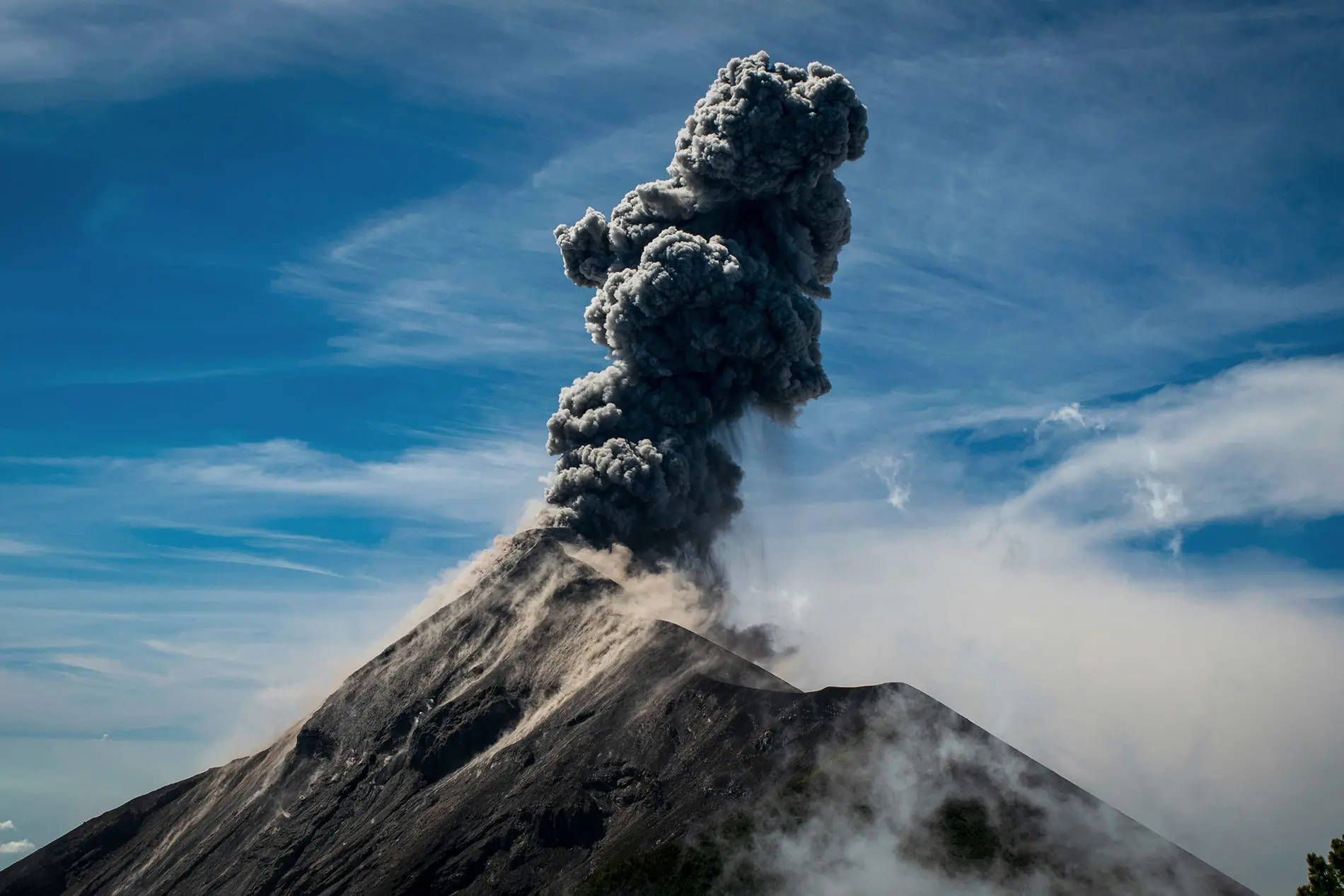
Over the past few millennia, there have been mysterious, prolonged cold periods. Connecting data on volcanic activity and glacier growth provides a new explanation: Eruptions altered the climate for centuries.
For around 12,000 years, the Earth has been in the Holocene epoch, a warmer period following a glacial period. During this epoch, however, there have been around 22 abrupt cold phases, each lasting up to several centuries and leading to the expansion of glaciers.
"Until now, there has been no convincing explanation for this phenomenon. It always seemed as though something was missing," says Alice Paine, an SNSF-funded postdoctoral researcher based at the University of Basel. Among the hypotheses put forward were the influence of icebergs drifting southwards, fluctuations in solar activity or changes in ocean currents.
Together with an international team, Paine has now investigated another idea in more detail – volcanic activity. Their study*, published in the journal Nature Communications, shows that volcanic eruptions were very likely the trigger for these prolonged cold periods. The researchers also provide a convincing explanation for the mechanism behind it.
Simultaneous volcanic eruptions and glacier growth
The team compiled all available information on major volcanic eruptions during the Holocene from a wide variety of sources. There were 51 in total, many of them in the western Pacific along the so-called Pacific Ring of Fire. This region is home to many active volcanoes, as tectonic plates collide and slide over one another there, which can trigger massive, explosive eruptions.
The timing of the volcanic events was determined with extremely high accuracy using ice cores from the Arctic and Antarctic, as well as by dating organic materials trapped in ash deposits. An updated dating of volcanic rock provided additional information.
The researchers then compared this data with the occurrence of prolonged cold periods during the Holocene. These phases were dated primarily using information on the maximum glacier advances. The analysis focused on moraines – the rock material carried along by the glacier tongues.
The study found that more than 80 percent of the glacier advances coincided with at least one of the volcanic eruptions. "By combining the results of our statistical analysis with existing palaeoclimate reconstructions, we are very confident that this is no coincidence. What’s more, the analysis also reconciles all the findings to date on these mechanisms," says Paine.
Temperature dynamics are thrown out of balance
According to these findings, a volcanic eruption can sometimes disrupt the Earth’s energy balance to such an extent that the global climate changes. The eruption propels sulphur particles into the atmosphere, which reflect incoming sunlight. This causes the Earth’s surface in the northern hemisphere to cool.
Arctic sea ice expands, reducing the amount of heat that the ocean releases into the atmosphere. This alters the course of ocean currents. A rainy low-pressure system around the equator also shifts southwards – and the cold zone expands.
"All these effects reinforce one another; it’s a snowball effect," says Paine. Eventually, it gets so cold that glaciers start to grow, particularly at higher altitudes such as in Switzerland.
For this to happen, however, certain conditions must be met. If the volcanic eruption is too weak, for example, the sulphur particles do not reach the upper atmosphere. If, on the other hand, it is too strong, the dust plume may collapse under its own weight, resulting in comparatively little sulphur reaching the upper atmosphere.
Paine emphasises that this phenomenon should not be confused with what happened in 1816, the ‘Year Without a Summer’. At that time, the eruption of Mount Tambora in what is now Indonesia led to a drop in temperature of several degrees, triggering crop failures and famines around the world. The effect, however, lasted only a year, until the dust particles had disappeared from the atmosphere again.
The situation is different during prolonged cold periods. "The sulphur particles simply get the snowball rolling. But their impact on the Earth system lasts for decades or even centuries, long after the particles have been washed out of the atmosphere."
Predictions are difficult
One big question is whether such a volcanic-induced cold period could also occur in the near future. "For the events we studied, the climate was, so to speak, in its natural state," she points out. At present, however, due to human influence, it is in an unprecedented state.
Some researchers believe that this could make the climate much more susceptible to disruption during events such as volcanic eruptions. Others counter that a volcanic eruption today is no more than a drop in the ocean – given the massive changes currently taking place in the atmosphere. "The more our climate changes, the more complex the processes become," says Paine. "There is still a huge knowledge gap to be filled here."