The science behind exceptional craftsmanship
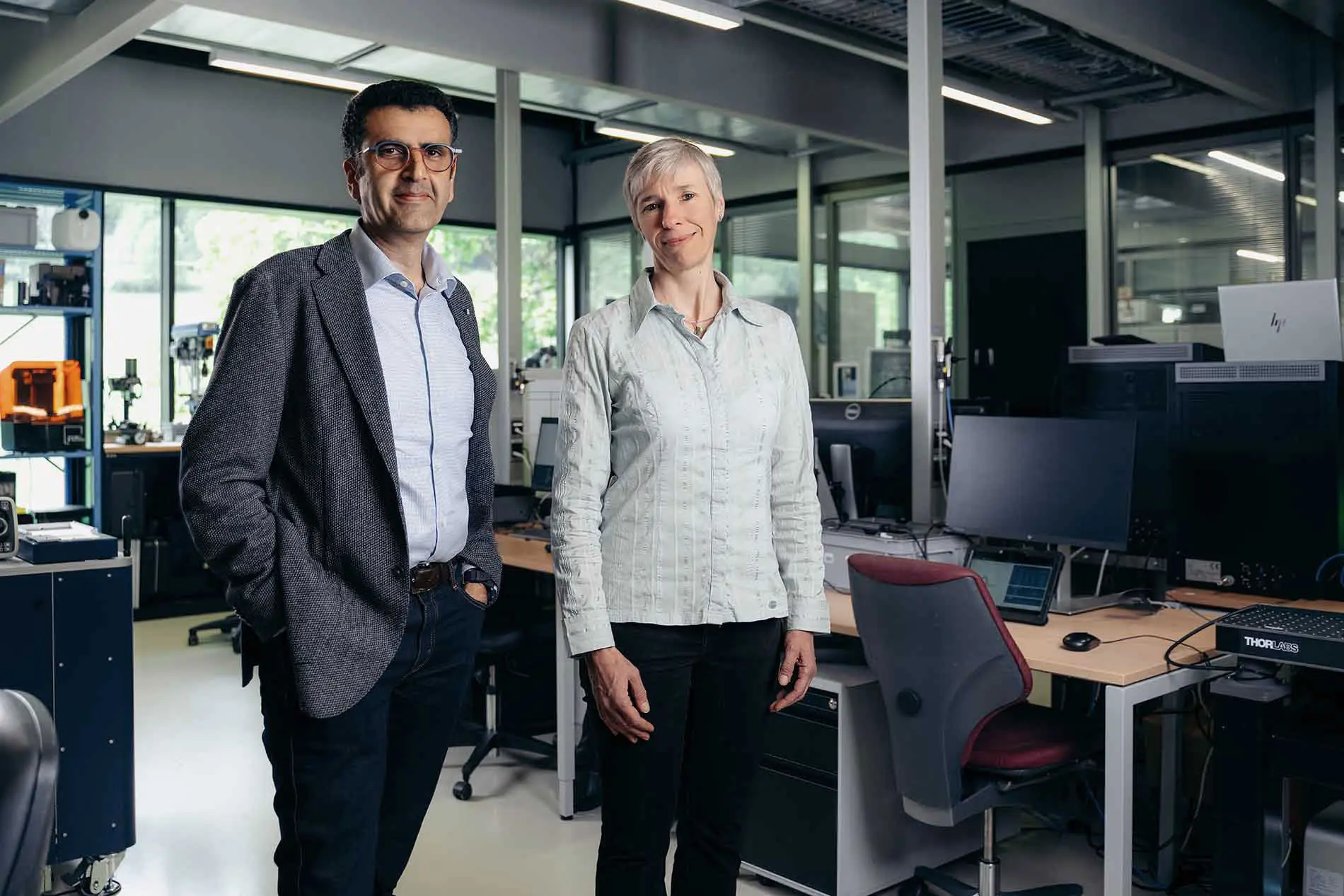
Behind every watch, piece of jewellery or writing instrument made by the Richemont Group – a major player in the luxury goods sector – lies a hidden network supporting its workshops: that of Swiss research.
Ultra-fast lasers. Micromachines making components invisible to the naked eye. Sensors derived from microtechnologies, tasked with measuring unique physical phenomena and continuously feeding data into analysis systems. Artificial intelligence capable of processing enormous volumes of data. These are all technologies, driven by science, that are fuelling the industrial competitiveness of the Swiss luxury giant Richemont.
The Group assembles a portfolio of some of the world’s most prestigious luxury brands – Cartier, Van Cleef & Arpels, Jaeger-LeCoultre, IWC, Vacheron Constantin, Montblanc and Chloé. In the 2024–2025 financial year, Richemont generated sales of 21.4 billion euros, with a profit margin of around 21 percent. It employs nearly 39,000 people worldwide, including more than 9,000 in Switzerland, where its headquarters and most of its manufacturing sites are based.
Basic research as the foundation for industry
"We structure our research and development projects according to their technological maturity," explains Vahid Fakhfouri, the company’s Head of Research and Innovation. "For the earliest phases – when we are still exploring scientific principles, materials or technological concepts – we collaborate with the Federal Institutes of Technology in Lausanne and Zurich. The closer we get to industrial application, the more these institutions become key partners."
In Switzerland, geography facilitates these interactions. Distances are short. "In just a few hours by train, we can access most of the Swiss academic ecosystem," emphasises Fakhfouri. "At our disposal are some of the world’s most advanced laboratories, unparalleled infrastructures and highly specialised expertise. This environment is extremely valuable for a major industrial player like Richemont." In addition, the similar educational backgrounds of the company’s scientists and their academic counterparts also foster mutual understanding and effective cooperation.
The Group’s collaborations with Swiss research span a very broad spectrum – from advanced materials and microtechnologies to data science and robotics. "Today, exploiting and leveraging data in isolation is no longer realistic," he asserts. The speed of change requires close collaboration with academic partners and specialist facilities, such as the Swiss Data Science Center.
From academic prototype to economic leadership
In Richemont’s workshops, technologies are a direct reflection of the close links between science and industry. "Over ten years ago, we began working on femtosecond lasers with the Swiss Federal Institutes of Technology," explains Fakhfouri. These lasers are capable of emitting extremely short pulses of light – on the order of a millionth of a billionth of a second. This ultra-short duration allows materials to be machined or modified with extreme precision. "Today, these technologies are used in our manufacturing processes and set us apart from our competitors."
The impact of research can also be measured in other ways across Richemont’s production lines. "Some of our high-speed micro-machining tools – which operate on a microscopic scale and help reduce costs, the carbon footprint and even the space required for manufacturing – were developed at Swiss higher education institutions," says Fakhfouri.
A decisive but fragile competitive advantage
More broadly, this collaborative dynamic highlights Richemont’s technological priorities, with several scientific fields set to shape the coming decades: sustainable materials, microfabrication, artificial intelligence, sensors and digital traceability. Fakhfouri makes the point that "AI will remain central. But we should not forget that there is no data without sensors: microtechnologies will therefore remain fundamental." The development of robotics also illustrates the Group’s specific approach for the future. "Our aim is not to replace people," emphasises Fakhfouri. "Our approach is primarily aimed at reducing the arduousness of tasks and preserving craftsmanship with high added value."
For industrial companies like Richemont, the entire Swiss ecosystem supporting research and innovation constitutes a major competitive advantage. "Instruments such as those of Innosuisse or CoBooster facilitate collaborations and make the return on investment more acceptable," says Fakhfouri. He notes the essential complementarity between basic research and applied innovation. "Projects supported by the Swiss National Science Foundation are crucial; without this groundwork, the technologies that subsequently find their way into industry simply would not exist."
In the Swiss economy, industrial competitiveness depends more than ever on the close relationship between scientific research and the manufacturing chain. But this balance is fragile, warns Richemont’s expert: "If public support for research were to decline, Switzerland would risk losing expertise and strategic assets."
The Swiss ecosystem, a lever for competitiveness – the example of CoBooster
Richemont’s collaborations with academia take many forms: student internships, support for theses, research mandates, continuing education courses and opportunities to access cutting-edge equipment. "For example, we use highly specialised imaging infrastructures at Empa and the Paul Scherrer Institute (PSI)," explains Vahid Fakhfouri, the company’s Head of Research and Innovation. Without these academic resources, certain advances would simply be impossible.
In this ecosystem that encompasses businesses and academic institutions, certain initiatives act as catalysts, as in the case of CoBooster. "The mission of this national, neutral platform dedicated to collaborative innovation is to transform ideas, industrial needs, patents or concrete problems into feasibility studies that bring together companies, start-ups, higher education institutions and research institutes," explains its director Joëlle Tosetti.
In practical terms, CoBooster members publish their topics on a secure platform – sometimes anonymously when confidentiality is an issue. Other organisations act as partners, making it possible to set up multi-disciplinary teams quickly and to share costs and risks. For Richemont, the impact is tangible. "CoBooster enables us to experiment with collaborations at minimal cost," confirms Fakhfouri.
Today, the CoBooster platform brings together more than 750 players nationwide – large companies, start-ups, specialist institutes, umbrella associations and higher education institutions – and has enabled 52 collaborative project teams to be established. More than 75% of the feasibility studies go on to become more ambitious projects, mainly projects funded by Innosuisse.
Links
- Basic research today - Innovation tomorrow
- Image for editorial use. Caption: Vahid Fakhfouri, Head of Research and Innovation at Richemont, and Joëlle Tosetti, director of CoBooster. © Sarah Adatte / SNSF (JPEG)
- Image with logo for editorial use. Caption: Vahid Fakhfouri, Head of Research and Innovation at Richemont, and Joëlle Tosetti, director of CoBooster. © Sarah Adatte / SNSF (JPEG)