A new type of wave discovered in Lake Geneva
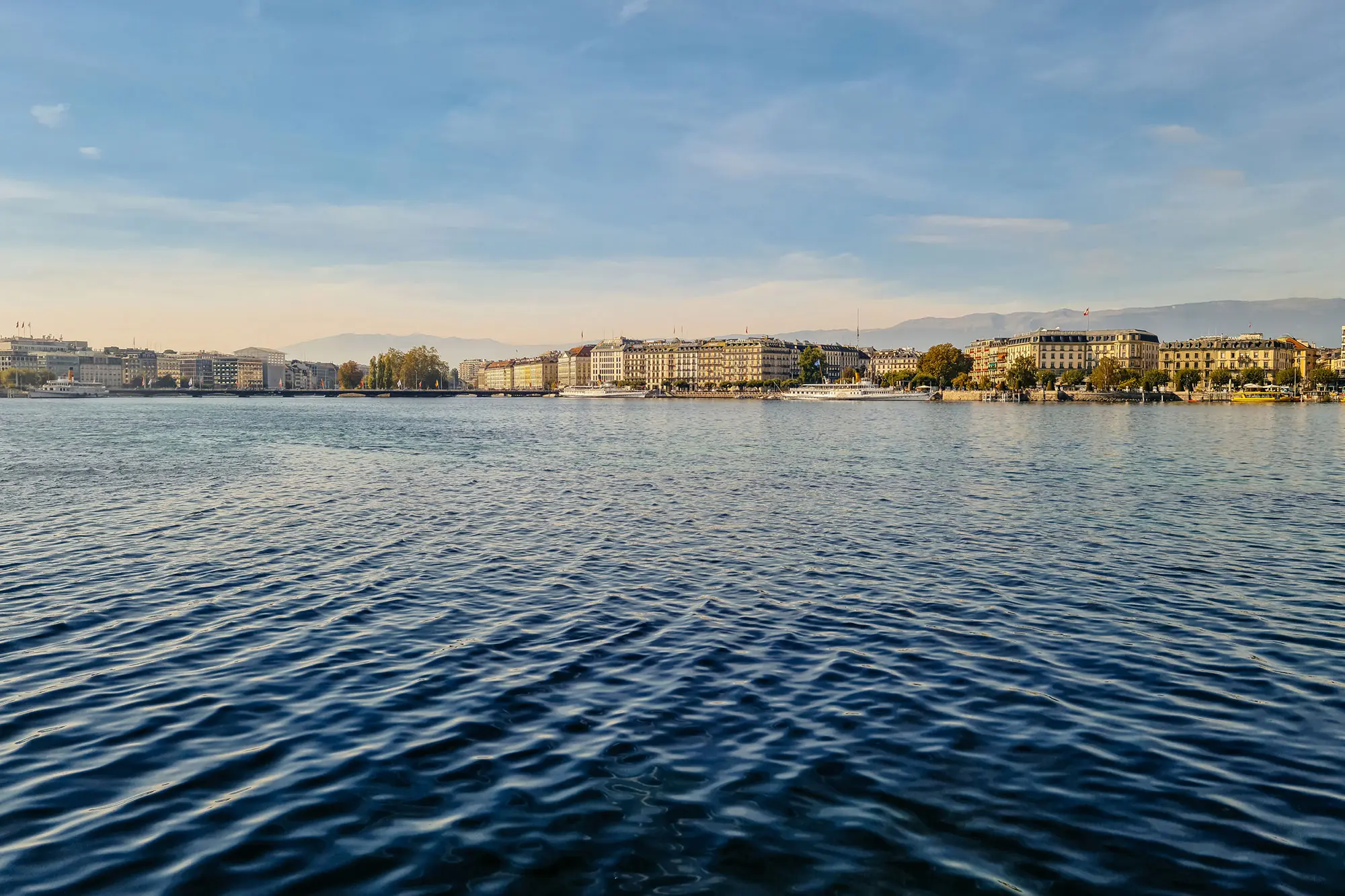
Every summer, a special wave travels around Lake Geneva. The phenomenon has only been discovered now, even though the currents are among the strongest in the lake and influence biogeochemical cycles in the nearshore zones.
Those going for a swim in Lake Geneva have no idea what is going on under their feet. Waves do not only form on the lake surface. Wave-like currents – known as internal waves – also flow through the deep interior waters.
While scientists have known about many of these for decades, the biggest lake in Switzerland and Western Europe still holds some surprises. As part of an SNSF-funded project (*), David Andrew Barry and his team have discovered a previously overlooked type of internal wave that undulates below the surface along the shoreline. This movement impacts the transport and dispersion of matter transported by the Rhone, for example.
The right conditions in summer
These special internal waves only occur in the summer months when relatively distinct layers of different temperatures are formed in the lake. Near the surface the water is a pleasant 20 degrees Celsius, while further down it is much colder – with temperatures as low as six degrees Celsius at depths of 300 metres. The transition layer between the warm upper layer and the cold lower layer is called the thermocline.
When the wind blows across the lake from the southwest, or a Bise blows from the northeast, it pushes the upper layers in one direction. When the wind dies down again, this water sloshes back to its original location. “The whole thing starts to rock back and forth,” explains the study’s lead author, Rafael Reiss, who is now conducting research at the University of Cambridge in the UK, with the support of the SNSF.
What is special about this newly discovered type of wave is that all three temperature layers move relative to each other – rather than two as in previously detected waves.
The resulting movement, known as a V2 Kelvin wave, has another peculiarity: the Coriolis force caused by the Earth’s rotation modifies the motion of the currents, causing them to become a shore-hugging wave that travels around the lake. The same mechanism is behind the familiar swirls in low pressure areas on weather maps, which can be seen particularly clearly in tropical cyclones, for example.
Around the whole lake in five days
The researchers from EPFL identified the wave through temperature and current measurements at various locations and depths in Lake Geneva. When analysing the data, they noticed a sharp oscillating pattern that could not be explained by known movements.
Modelling ultimately showed that the observations matched a V2 Kelvin wave. In theory, the occurrence of this type of wave is nothing unusual. But until now virtually no practical studies have sought to examine and detect them in real lakes.
The analysis revealed that the wave travels around the whole shore in five days. It always rotates in an anti-clockwise direction around a fixed point in the middle of the lake, because V2 Kelvin waves are a special type of standing waves.
This means they have nodal points around which the water oscillates – like the strings of a guitar that are fixed at both ends. By contrast, wind waves propagate on the lake surface in only one direction.
The measured effect is strongest at a depth of 30 metres, around one kilometre from the shore. As the wave passes through, the underwater temperature layers move up and down by about 25 metres and current velocities reach up to 30 centimetres per second.
"The resulting currents are by far the strongest that we’ve measured this summer and among the strongest in the lake overall,” says Reiss. Since the movement is so powerful, it impacts the transport of sediments, pollutants and nutrients in nearshore zones.
Besides the Rhone, these substances also enter the lake from the many small tributaries and wastewater outfalls, particularly on the northern shore of Lake Geneva.
The researchers can now model the dispersion of sediments, nutrients and pollutants by this new wave type. For example, a simulation showed that the particles suspended in the water were transported along the shoreline by the V2 Kelvin wave throughout July. This dispersed them over more than half the length of the deep basin, known as the Grand Lac.
Likely more common on other lakes as well
It is somewhat surprising that no one has noticed the V2 Kelvin waves before, even though Lake Geneva is one of the most studied lakes in the world. According to Reiss, one reason for this is probably that measurements have not been taken in the right locations until now.
If the probes are placed too close to the shore or at the wrong depth, they may detect the strong currents but will only show one or two of the characteristic three layers. This is probably why no one has made the connection to this new wave form until now.
The research team is confident that V2 Kelvin waves also exist in other lakes of similar size and depth to Lake Geneva. An obvious candidate is Lake Constance. “According to our findings, this is not something exotic that can only be expected in Lake Geneva. You just have to look closely and know what you’re searching for,” says Reiss.