Science and art bring light pollution to life
Through an immersive installation, the ALANart project brings to life research findings on light pollution and insect decline. This is being recognised with the 2026 Optimus Agora Prize.
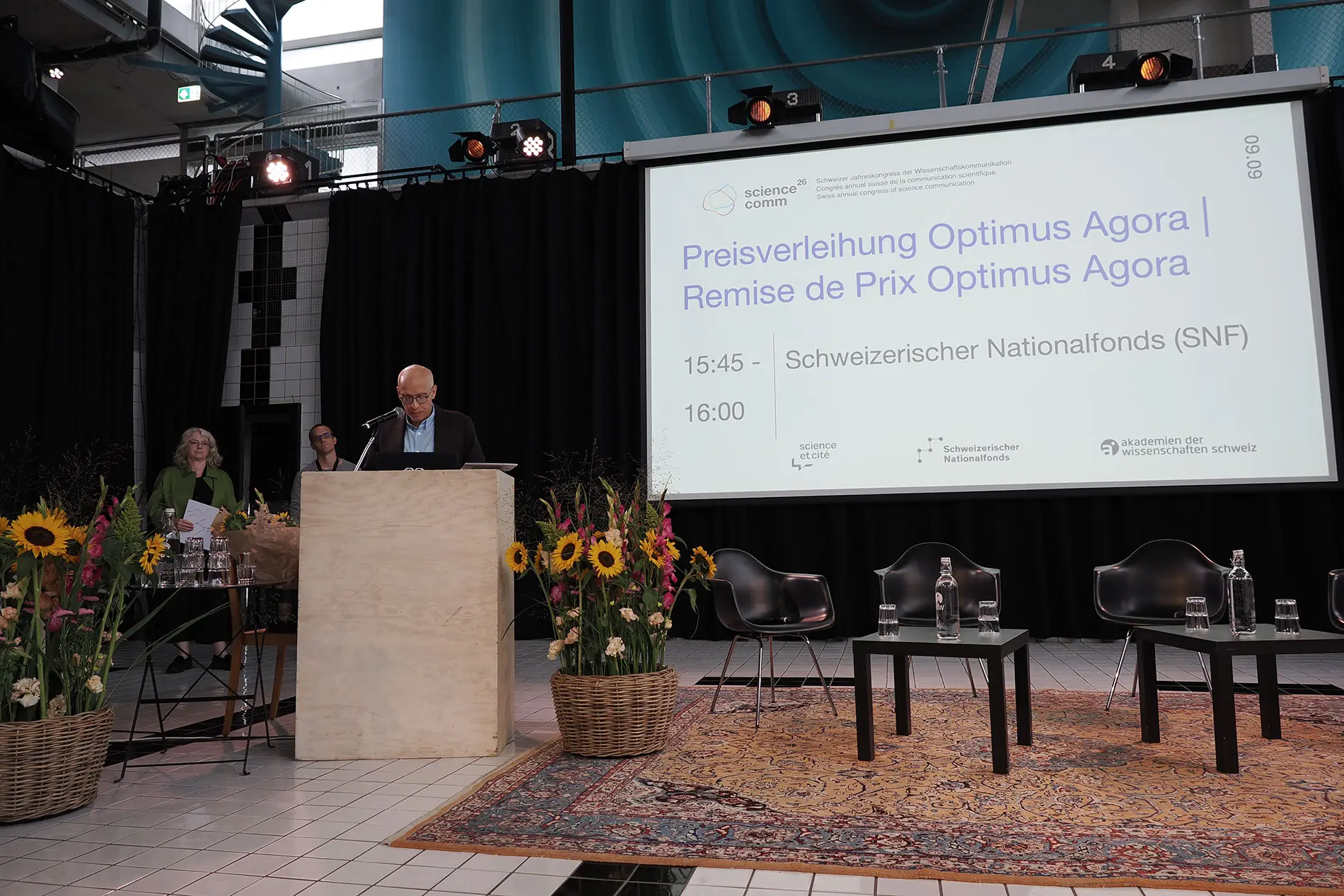
On 9 September 2026, the 15th edition of ScienceComm took place in Lucerne. At this annual Swiss congress of science communication, the SNSF awarded the 2026 Optimus Agora Prize to the ALANart project. ALAN stands for artificial light at night, and the project brings to life the impact of artificial lighting at night on ecosystems. Through this prize, the SNSF supports projects that make science accessible to a wide audience and promote dialogue (see box).
Ecosystems out of balance
The project explores phenomena that we have all observed at some point – such as insects swarming around a lamp at night. This might seem harmless, but it is not. Artificial light at night disrupts entire ecosystems and contributes to insect decline.
To bring this issue to life, a multidisciplinary team developed an immersive art installation as part of the ALANart project, which raises awareness of more ecologically responsible lighting. In addition, moderated events, panel discussions, exhibitions and workshops encourage public engagement.
The project team includes biologists Janine Bolliger, Nicola Van Koppenhagen and Federico Ferrari from the WSL; lighting engineer Jörg Haller from the Zurich Cantonal Electricity Works (EKZ); social scientists Norman Backhaus and Nitin Bathla from the University of Zurich; artist Thijs Biersteker; Sophie de Krom, director of the Woven Foundation; and landscape architect Yves Brocker from Enea.
In this interview, Janine Bolliger, Nicola Van Koppenhagen, Thijs Biersteker and Jörg Haller explain the project’s background.
What is key to encouraging people to be more mindful about their use of artificial light at night?
The science is clear: Even simple measures such as dimming lights, focusing the beam of light or switching them off completely can significantly reduce the negative impact on the environment. To get that message across, the first step is to reach the public. It is crucial to raise awareness of the issue of light pollution and to present appropriate courses of action. Ultimately, the aim is for the public to learn about the positive effects of these measures, helping people feel personally invested in reducing light pollution.
Is art particularly well-suited to this?
Yes, facts alone rarely move people, whereas emotions certainly do. Translating facts into art elicits that response, making scientific content accessible and tangible. It strikes a chord with people and makes them curious to find out more about complex topics. At its best, art can help to ensure that an issue such as light pollution remains firmly in the public consciousness.
How can your findings be put into practice?
Light at night is used to see more clearly and to ensure safety, but also for aesthetic reasons – or simply because it’s possible to light things up with LEDs, which are so cheap and energy-efficient these days. However, it is often forgotten that the night is not simply an extension of the day. Many organisms are nocturnal and have adapted to low-light conditions. Artificial light at night is disruptive. We want to demonstrate that a mindful and responsible approach to lighting at night not only protects ecosystems and the organisms within them, but also improves the quality of our own living environment. After all, darkness also lends itself to peace and rest.
What audiences are you aiming to reach?
On the one hand, a special exhibition enables us to reach professionals who have, until now, often had little exposure to environmental issues. These include architects, lighting designers, urban planners and landscape gardeners. On the other, we would like to reach the general public through exhibitions that are openly accessible. Through interviews, we hope to gain a better understanding of how the combination of scientific information and artistic expression is perceived, and how it can change people’s attitudes or perceptions.
Stay in San Francisco
The SNSF, in collaboration with Swissnex, awards the Optimus Agora Prize to support the communication potential of funded projects. Swissnex is the Swiss Confederation’s global network for education, research and innovation. The prize is awarded to outstanding projects selected from the annual Agora call for proposals. The winners are awarded a stay at Swissnex in San Francisco, where they can take part in exhibitions and training programmes.